Mastering and Final Thoughts

In this final post I want to discuss my process for mastering the tracks and some reflection on the project. Here is a link to the finished product:

https://f4rside.bandcamp.com/album/bamboo-peach-boy

As mentioned in my post about distribution, we decided for the moment to only upload our music to independent sites and not to work with a distributor, primarily so that we would have the chance to continue working on together and produce a full album in the future while still having something for this particular deadline. No longer needing a distributor meant that I felt using an AI mastering service would not be very beneficial on its own, so I decided to master it myself. I have even less experience with mastering than mixing, but I have a basic three-step process to follow which involves EQ, compression and limiting. I learned this process from a video tutorial by Rob Mayzes (2019).

For EQ, he recommends to use reference tracks and to focus on the top end and lower end until you become better at referencing and can then also focus on lower mids and upper mids. For both tracks I did similar things, using a slight cut in the mid/lower mid range to remove some cloudiness and using a high shelf to add more air.
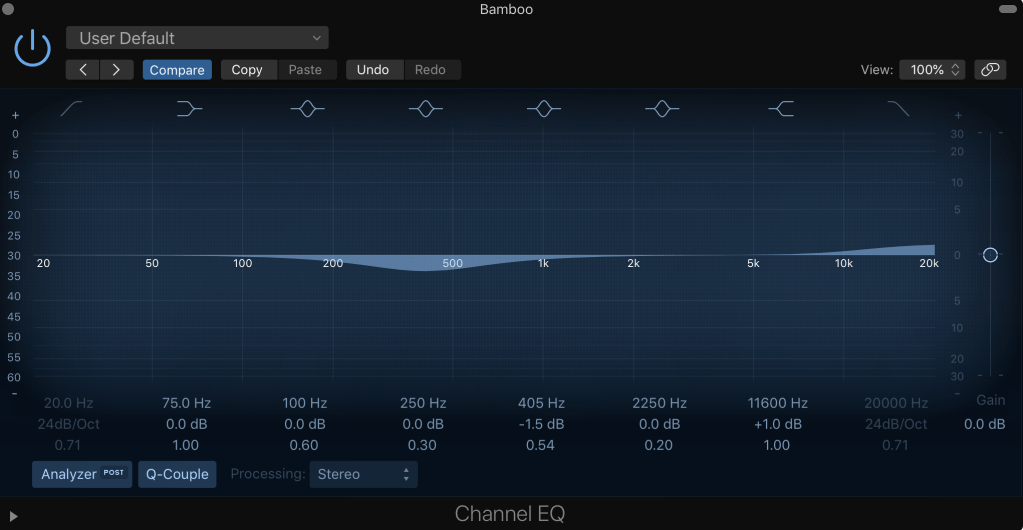
The next step is compression, and I used the same compressor for both tracks with a low ratio and softer knee so it would only have a gentle effect. I also set the attack time fairly slow so that the drums would have time to cut through.
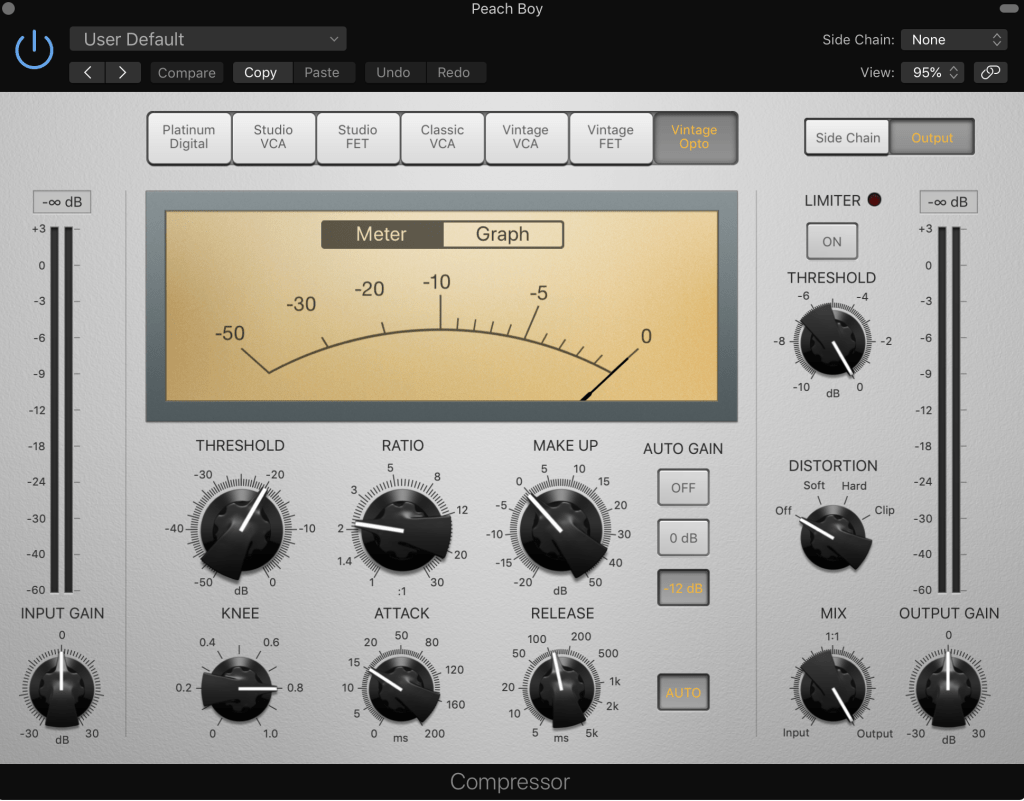
Finally I used a limiter to make sure the loudness was about right to match other commercial tracks. This three step process is very easy to follow, though my main limitation was not having a suitable listening space to do it in but this can’t be helped. I also experimented with adding saturation in with the iZotope vinyl plugin but ultimately decided I preferred it without. In the future when I have more time and budget available I would like to be able to work with a mastering engineer instead, but for now I wanted to try and improve my own skills through practice.

At the end of this project I asked Ciarán if he could make some comments on how he found our collaboration, and this is what he wrote:

The collaborative experience while working with Damon for this project was my personal highlight while working on these tracks. The back and forth conversations happened right from the beginning, sending and discussing ideas. Of which, the most impressionable ones seemed to fuse and materialise into something incredibly organically. This connection greatly helped us to clarify and whittle down these ideas to create the stylistic, and unique sound that came from the melding of both our passions. Although we hit a couple of technical difficulties (as expected when the bulk of our collaboration took place online!), we totally overcame them, and in my personal opinion, ended up helping us shape the tracks into what they are. These limitations can boost creativity, especially when looking at the seemingly endless expanse of two musicians’ idea spectrum at the beginning of a project. Working with Damon has been a total delight, and we already have plans to make more!

I am very happy that the project was still a success despite some complications and I look forward to continuing it in the future.

References:

Mayzes, R. (2019). How to Master Your Music (3 Easy Steps). Available at: https://www.youtube.com/watch?v=WhBWCR23pp0&t=1036s [Accessed 14th May 2020].
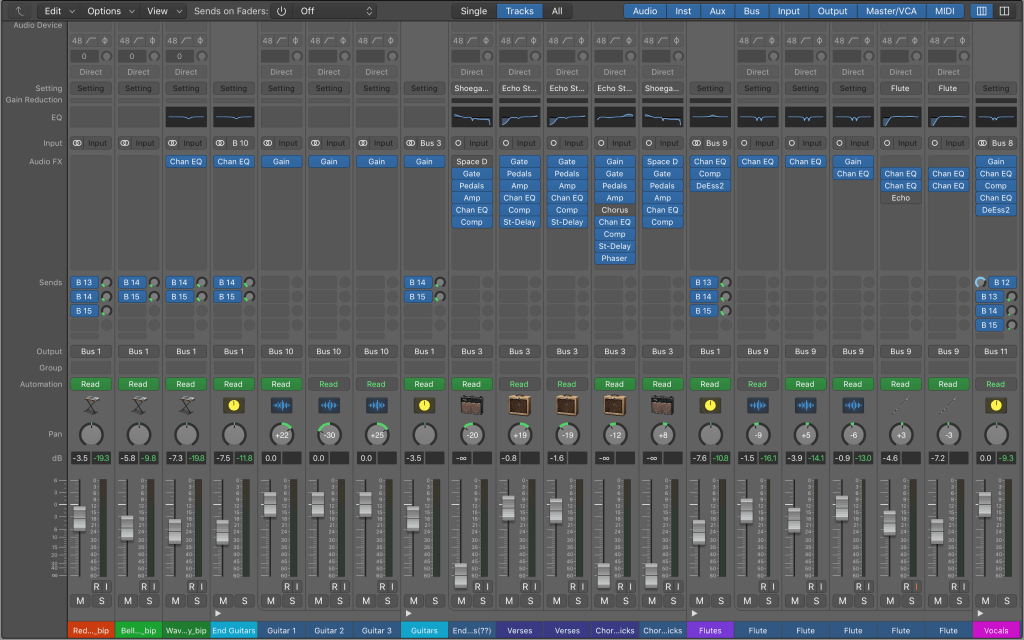
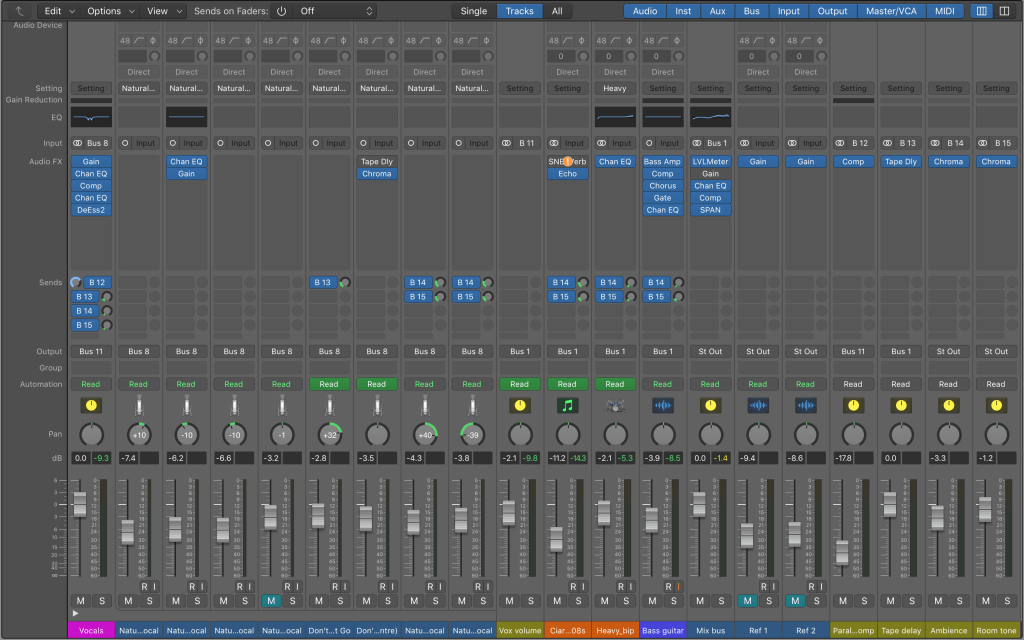
Mixing Second Track

In this post I want to discuss my process of mixing the second and final track. I used the same mixing workflow as in my post about mixing the first track as I found it worked very effectively. Ciaran sent me his recordings of vocals, guitar, flutes and bass guitar, as well as some additional VST drums. He also offered to help out with the mixing process a little by editing timing issues and adding effects to the guitar tracks. After receiving these I reminded him that I’d also wanted some material to use in the end section of the track, so he went on to send me improvised guitar and flute recordings which I chopped up and arranged.

During the process I was struggling more with the vocals in comparison to the last track, in particular as they had a wide dynamic range, so I decided to do some research on mixing vocals. In an interview with Neil Rogers (2019), Jack Ruston expressed the importance of having a vocal style which matches the track, for example if the vocal timbre is too soft and has to be made louder to compete with a large track, this will cause some incongruence. Ciaran always double tracks his vocals out of personal preference, and though I had originally decided to have only one track of vocals heard in the verses I decided to bring the second back in as well as this is quite a busy track which needed larger and less intimate vocals. In the same interview, Boe Weaver explain how they make an effort to not get lazy with vocal mixing and the importance of remembering that what works may change each time, so starting with whatever has worked well previously may not be ideal. I took this into account by treating the process of mixing vocals differently from last time, for example I added a tape delay to add more space and less intimacy to fit the mood of the track. I also used this tape delay on other parts of the mix such as the flutes. I still used parallel compression like I did last time as I like how it subtly adds thickness. The most highlighted point from the interview was that micro-managing vocal levels is very important, so I made sure to spend extra time automating the vocal line (mostly by drawing it in while listening) after I had achieved a good static balance of all the tracks.

Cooper (2011) recommends when mixing a lead vocal to use a de-esser first to remove sibilance and following with a soft-knee compressor to control the dynamics before doing any EQ. I usually add a de-esser in later on if I think the vocal sounds too harsh which is what I did with this mix, but I will try out using it first in the future. In contrast, Kindred believes compression is all about developing the sonic character of the vocals rather than minimising how much automation is needed (Rogers, 2019). This further emphasises to me that automation is the most important step in controlling dynamics, so this has changed my mixing approach to rely less on compression to achieve a consistent sound.

The final piece of advice I came across which stood out to me was from Dave Pensado, who believes that you are never done with a mix, you just run out of time to work on it (Droney, 2004). This helped me with time management of this mixing process as I realised there is only so much you can work on a track before you stop seeing significant improvements, and it is then time to consider it finished, even if it isn’t perfect. I think this approach has saved me a lot of time rather than taking ages to tweak small details.

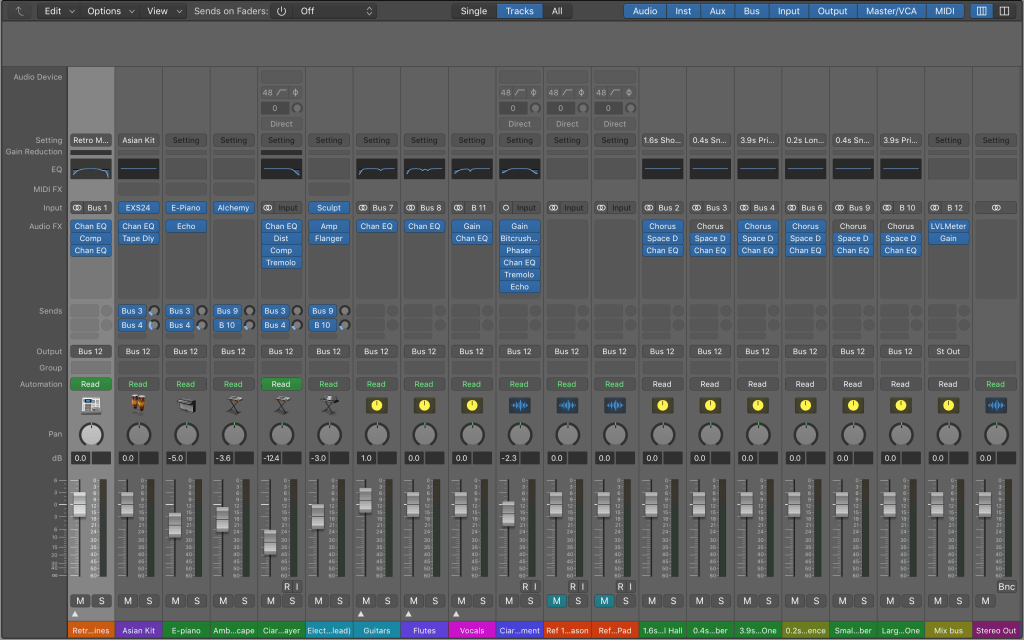
Here are screenshots of my mixer when I was mostly finished with the process:

In the next post I will discuss how I mastered both tracks and why I decided to master them myself instead of using AI mastering or working with a mastering engineer.

References:

Cooper, M. (2011). Mixing the Ultimate Lead Vocal, pt. 1. Electronic Musician, Vol 27(8), pp. 80-82.

Droney, M (2004). Mixing Strategies of the Pros: 3 Top Engineers Take You Inside the Mix. Electronic Musician, [online] Vol. 20(5), pp. 42-61.

Rogers, N. (2019). How Engineers Get Vocals to ‘Sit Right’ in a Mix. [online] Soundonsound.com. Available at: https://www.soundonsound.com/techniques/how-engineers-get-vocals-sit-right-mix [Accessed 3rd May 2020].

Working with Audio Recordings versus Working with VST Instruments

We have had some technical issues over the past week or so, mostly involving microphones not working, which means we are now behind schedule again. This can’t really be helped due to the lockdown so I am not majorly concerned and now that we have working microphones all recording has been finished, leaving just the mixing of the second track and mastering of both. I also finished the cover art some time ago.

In this post I wanted to discuss how this collaboration has been beneficial as I get to use recorded material rather than my own use of VST instruments. The main reason is for authenticity, with VST instruments there is only so much realism which can be achieved, especially for non-keyboard instruments such as flute or guitar. For example, when finishing the first track I added my own electric guitar sound but Ciaran wanted to replace it as it’s ‘not real guitar’ which I then realised was a good improvement. Of course, from the beginning of the project I had wanted him to record flutes as I don’t have a virtual version of those, and I imagine it is fairly hard to create realistic virtual flutes, but I have now further realised the benefits of using audio recordings.

With a MIDI input you can only control note velocity and placement in order to give expression, rather than small authentic details and human imperfections that come from live performance. This led me to look into the ‘uncanny valley’ theory, developed by Masahiro Mori in 1970 it concerns robots and virtual characters where being close to human likeness causes the people to react negatively (Schneider et al., 2007). Avdeeff discusses how this can also be seen in the audio world when a lack of ‘soul’ and ‘human creativity’ is perceived, for example in the fourth movement of Hiller’s Illiac Suite (1956) which was composed using Markov chains and arguably lacks a strong narrative, which causes unease (Avdeeff, 2019, p. 4-8). I can see how this would relate back to my practice, perhaps not on the same extreme level of unease, but in how a ‘too perfect’ MIDI file could be perceived as boring, expressionless, and lacking humanity.

I have learned a lot over the course of this project about mixing audio recordings, especially vocals as I don’t have much experience with this, for example by reading this article on parallel compression. Roads (2015, p. 371) explains how pop music has very defined stages of production from songwriting to performing and on to mixing, but in contrast in electronic music these phases become tangled together and mixing happens throughout almost the whole production process. I have realised that I prefer the workflow of pop music as having defined stages of production feels more manageable compared to the constant tweaking which is needed in electronic music, though I have ended up combining both approaches in this project by adding in and mixing virtual instruments both before and after the recording stage.

References

Avdeeff, M. (2019). Artificial Intelligence & Popular Music: SKYGGE, Flow Machines, and the Audio Uncanny Valley. Arts, Volume 8(4), pp. 1-13.

Mayzes, R. (2020). 8 PARALLEL COMPRESSION HACKS: TAKE YOUR MIXING TO THE NEXT LEVEL. Musicianonamission.com. [Online] Available at: https://www.musicianonamission.com/parallel-compression-guide/?utm_source=ONTRAPORT-email-broadcast&utm_medium=ONTRAPORT-email-broadcast&utm_term=%28PROMO%29+Compression+Breakthrough+Launch&utm_content=8+parallel+compression+hacks&utm_campaign=23032020 [Accessed 28th April 2020].

Roads, C. (2015). Composing Electronic Music : A New Aesthetic. New York: Oxford University Press.

Schneider, E., Yifan, W. and Shanshan, Y. (2007). Exploring the Uncanny Valley with Japanese Video Game Characters. Paper presented at the DiGRA 2007 Conference: Situated Play, Tokyo, Japan, September, pp. 24–28.

Some Thoughts on Distribution and Future Collaboration

After a conversation where we decided we would like to carry on working together after this deadline, I had some more thoughts on how to distribute the music. Historically, music artists needed a record label to help distribute music, but the change to online distribution has allowed artists to take on a do-it-yourself approach (Bockstedt, Kauffman and Riggins, 2006, pp. 8-18) which makes the process of releasing music a lot easier for beginner artists like myself, and I am very grateful for.

At the moment, I would prefer to use independent streaming sites (such as Bandcamp) where the artist has full control over the music rather than to pay for a distributor to upload it to outlets which don’t allow artists to directly submit content (such as Spotify). The main reason for this is I would rather wait until I have a substantial portfolio of music before trying to build a presence online, and paying to do so (even though there are a lot of very affordable distributors out there). Another thing to consider is that features such as the playlists on Spotify are leading listeners back to consuming singles instead of albums (Pack, 2017) and in order to get onto these playlists your track has to fit comfortably into a specific genre which people are looking for. As our collaboration wasn’t aiming for one particular genre and was more an exploration of how our separate musical styles would meld together in a hybrid genre, and for our own enjoyment, I feel it would not fit in well with the ideals of these streaming services.

Regardless, we would very much like to take our collaboration further and once we have completed a substantial project, perhaps even a full album, I will look into trying to establish a presence online by distributing to various different streaming sites. The two singles for this project will instead be uploaded to independent sites (Bandcamp and Soundcloud).

References:

Bockstedt, J., Kauffman, R., & Riggins, F. (2006). The Move to Artist-Led On-Line Music Distribution: A Theory-Based Assessment and Prospects for Structural Changes in the Digital Music Market. International Journal of Electronic Commerce, Volume 10(3), pp. 7-38.

Pack, B. (2017). The Complete Guide to Music Distribution. Theproaudiofiles.com. Available at: https://theproaudiofiles.com/digital-music-distribution/ [Accessed 3rd May 2020].

Writing Process for the Second Track

First, an update on sticking to the schedule. After the decision last week to move everything forward by one week, everything has been going just fine and this second track should all be recorded by Tuesday.

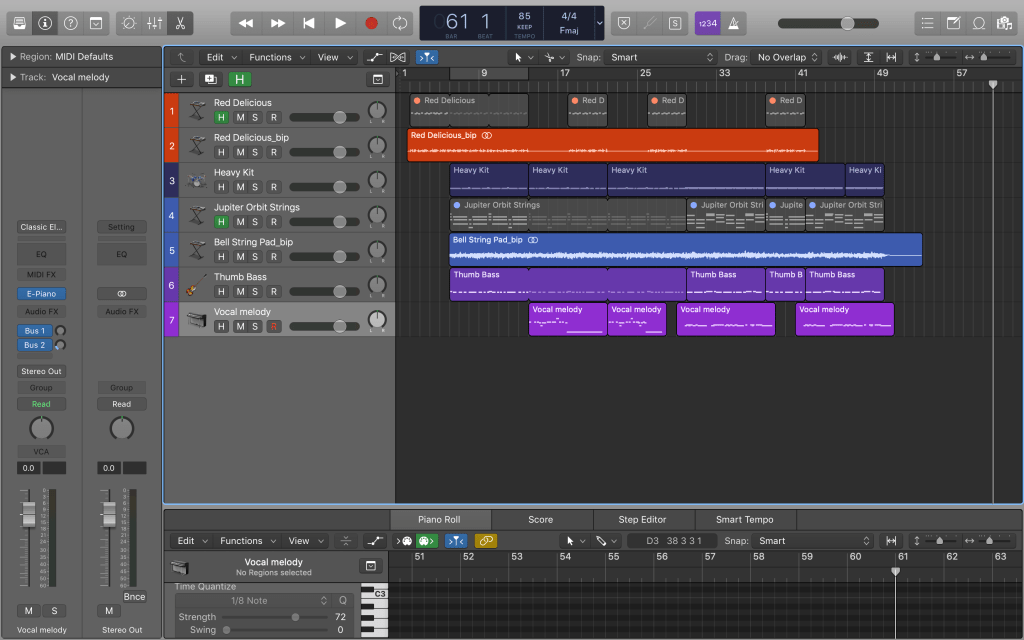
In this post I want to discuss my writing process for the second track ‘Peach Boy’. I set the goal of completing a draft of the track in one afternoon to practice working more efficiently. I made use of the music making workflow discussed in the last post, which suggests starting with either lyrics, melody or instrumentation, then work on structure and transitions, before repeating two more times and picking the best song (Mayzes, 2018). I started with instrumentation by choosing a lead synth, drum kit and another synth to play the chords. I changed the workflow slightly by creating a structure and melody before writing lyrics as creating a solid structure was something I found difficult with the first track. I also did not write three different songs as suggested as I wanted to save time. Overall I would say even though I changed some aspects of it to fit my time frame, this workflow was generally successful and I will carry on using it in the future. Here is a screenshot of the track I sent to Ciarán:

I had to bounce in place two of the tracks as he does not have the ‘Alchemy’ synth, which is my go-to when I need to work quickly as it has lots of very good preset sounds which are also very customisable. I also added in a bass line which I asked him to improve, and a piano version of the vocal melody as we found this was a sufficient way to communicate that in the last track. I explained to him that after this written section of the song I would like to end with a very long bridge-type section with vocal and instrumental ad-libs. Other than this, I once again gave him the freedom to add any creative ideas he wanted to the project.

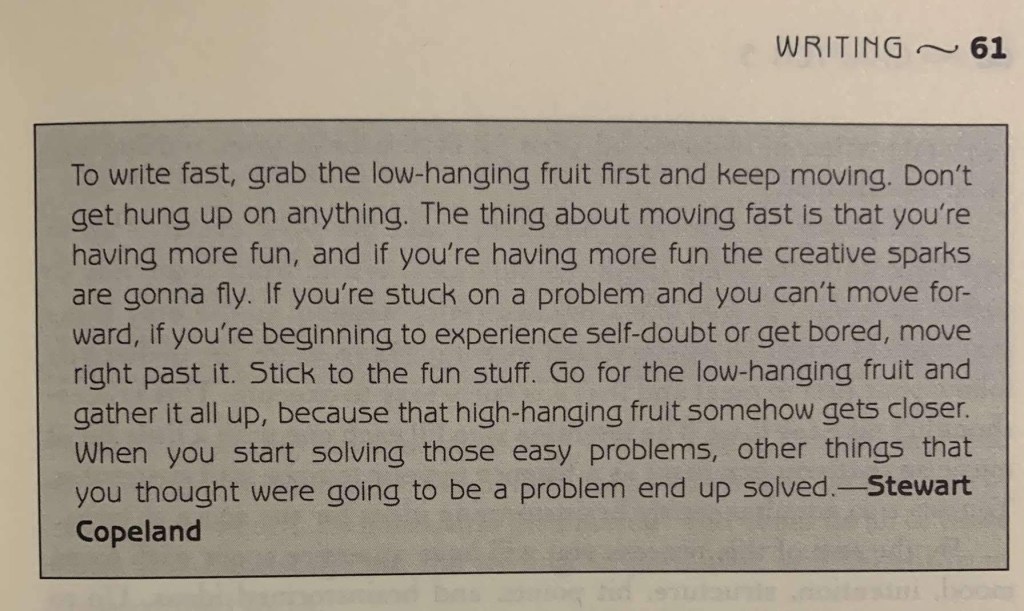
I recently read some of ‘Guerrilla Film Scoring’ by Jeremy Borum, which although film scoring is not entirely relevant to the project it had a quote which stood out to me:

Quote from S. Copeland (Borum, 2015, p. 61)

This quote really inspired me to not worry about trying to achieve perfection in writing music and to focus on the fun and creativity.

When looking for ideas on how to improve my writing process I watched George Clanton’s interview on the YouTube show Vinyl Rewind where he discusses his most recent album ‘Slide’ and other things he has been working on. He explains how his musical training was very basic and therefore his compositional process is also basic, with simple chords and a few notes at a time, and this makes his music more accessible and more memorable because of its simplicity (Vinyl Rewind, 2020). One particular quote which caught my attention is ‘I typically compose with it sounding like s***, because something about the cloudiness of the sound helps me to hear things which aren’t there yet’. I can relate to this as I think most of the instrument presets in DAWs sound too clean, so I applied this to my workflow by creating the distorted sounds I wanted first and then writing for them without worrying about clipping or an unbalanced frequency spectrum which can be cleaned up later on.

Finally, I looked for ideas on how to write better lyrics and read a post about the technique ‘object writing’ by Marc Davis (2019) where you choose an object each day and write about it for 10 minutes. I only had time to try it for a few days but I feel that it helped me to write down ideas faster and in the long run it is supposed to help with creative and highly emotive writing.

References:

Borum, J. (2015). Guerrilla Film Scoring: Practical Advice from Hollywood Composers. Maryland: Rowman & Littlefield.

Davis, M. (2019). Never Run Out Of Lyrics With Object Writing! positivesongwriting.com. [online] Available at: https://positivesongwriting.com/never-run-out-of-lyrics-with-object-writing/ [Accessed 22nd April 2020].

Mayzes, R. (2018). The Music Making Workflow. [online] Musician On A Mission. Available at: https://musicianonamission.training/workflow-charts [Accessed 13th April 2020].

Vinyl Rewind (2020). George Clanton interview | Vinyl Rewind. Available at: https://www.youtube.com/watch?v=q_ACOjleCU4&t=719s [Accessed 20th April 2020].

First track complete – review of progress

Now that the first track has been fully recorded and edited I wanted to review progress so far and discuss some issues we faced and enhancements made in working collaboratively.

We are about a week behind schedule due to difficulties during this stressful time but this does not concern me, there is enough time to simply move the schedule I proposed in the last post forward by a week. I feel that the project is going well overall so far but in order for us to work quickly and efficiently I have decided to start using a workflow template which I will discuss in more detail later on.

One main issue we faced was difficulty in communicating ideas through online messaging, for example I could write lyrics but not explain how I wanted the vocal melody to sound. We decided our collaboration could be enhanced by using video communication as well so we can discuss ideas in real time and play or screen share our ideas to each other. This also proved very helpful when we discovered a file sharing glitch between our two different versions of Logic where parameters of some plugins would change randomly. By both working on the project together at the same time I would know if Ciarán actually changed something or if it was due to the glitch. We also had some significant issues with missing audio files but managed to fix this through trial and error.

I decided I wanted to find a workflow template to follow in order to mix more efficiently as I do not usually work with a combination of live recordings and virtual instruments. I decided to use one from musician and mixing engineer Rob Mayzes who I have been following online for some time. I really like his approach to mixing as it is a top-down approach called ‘slow focus mixing’ (Mayzes, 2016).This approach focuses on mix bus and group bus processing first before refining individual tracks. This is a very efficient and much less overwhelming approach to mixing, especially for beginners like myself. The template includes steps for songwriting, recording, editing, mix preparation, mixing and mastering and helps to make a clear line between each of these steps to improve efficiency (Mayzes, 2018). I have used the editing and mix preparation sections so far and just begun the actual mixing phase by volume balancing.

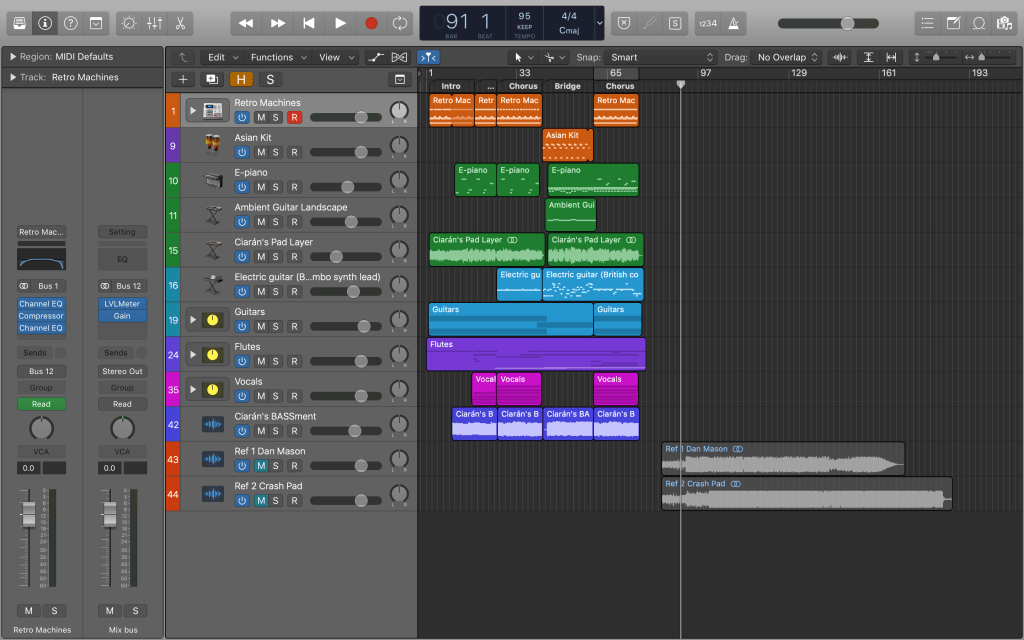
This is how the project looks so far with everything tidied up and ready to begin the actual mixing phase. In my schedule I left the mixing until after both tracks were complete but instead I have decided it would be better to begin mixing now in order to have more breaks between mixing sessions to prevent ear fatigue which is often a problem for me. I will do some of the major group and mix bus processing now and save smaller refinements for the allotted time in my original schedule. Other than slow focus mixing, some things which I am newly implementing with this workflow are fixing time and pitch issues and using subtractive EQ first, which I would usually do when I reach each individual track. I also do not usually mix in mono or use reference tracks until the very end, so it will be interesting to see how this affects workflow and the outcome.

Moving forward with the next track we will also be using the suggested songwriting workflow as I discovered with the first track that songwriting is not something either of us are very confident with.

References:

Mayzes, R. (2016) Backwards Mixing for Better, Faster Mixes | musicianonamission.com [EQ Challenge]. Available at: https://www.youtube.com/watch?v=SY7c2p2BR_Q [Accessed 13th April 2020].

Mayzes, R. (2018). The Music Making Workflow. [online] Musician On A Mission. Available at: https://musicianonamission.training/workflow-charts [Accessed 13th April 2020].

Work in Progress Presentation

Script:

Slide 2: I came to uni with the hope of being able to produce my own music but I had no idea how to do it. Alongside this course I’ve been learning how to use Logic Pro. For this project, I decided to collaborate with my friend Ciaran who is a freelance composer. We have been friends since I started uni and we really wanted to make some music together because we have a lot in common in terms of musical interests and styles.

Slide 3: I have some experience of making my own music, for example my EP from a few months ago. I usually use a combination of samples and virtual synthesizers to make music in a chill, lo-fi electronic kind of style. I also find that my interest in classical piano, particularly Impressionism, helps to inform compositional choices.

Slide 4: Ciaran is a freelance composer who is mostly interested in video game music, though he has done work for other kinds of media as well such as short films. He has written in all different kinds of genres that you might find in games e.g. chiptune, synthwave, orchestral, etc. He is a good singer and guitarist but has also been learning to play the Japanese shakuhachi flute. I think all of these skills could be very interesting and useful in this project. He also has his own recording equipment so we won’t need to use the studio.

Slide 5: When thinking about collaboration one of the first things which came to mind for me was the collaborative work of vaporwave artist George Clanton and his ‘hero’ alternative rock artist Nick Hexum of 311. They released two singles in September last year and have released a few more since then. The combination of Hexum’s signature guitar and vocals combined with Clanton’s vaporwave-style electronic soundscapes works really well together and I was hoping to have the same kind of success in my project.

Slide 6: the main aim of this project is to have a pair of tracks to post on major streaming sites such as Spotify and Apple Music as we would both really like to have music on these sites. I would also just like more practice at producing music and thought this could be a really fun project.

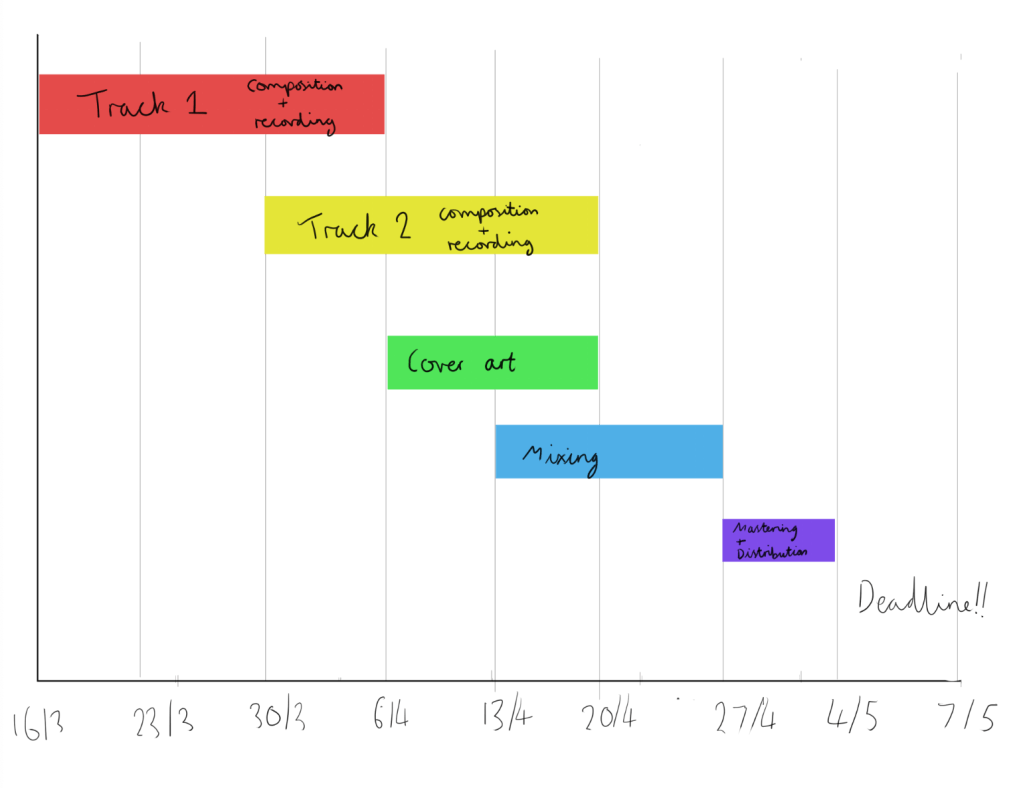
Slide 7: Here is a Gantt chart I made this week for us to follow. As you can see I have left a fair bit of leeway for each step as plans keep changing recently. 6 total weeks to write and record both tracks should be plenty of time and we are already working on the first. I will be doing the cover art myself because I recently started doing digital painting and I really enjoy it. I’ve given two weeks for that but now that I have some ideas for it I may start it earlier. I’ve then given two weeks for mixing which I was originally going to do in the sound editing booths in Scott but as that is no longer possible I will do it at home with a combination of headphones and speakers. With electronic music mixing mostly happens as you go, so this will probably not take very long anyway. Finally, I will just need to choose a distributor and release it in time for the deadline. For mastering I have been looking into affordable mastering services, but may just do it myself if needed.

Slide 8: so far after a lot of discussion about themes etc. we have started working on the first track. I did some synth chords, drums, extra percussion and the little electronic piano decoration. Ciaran has added some flutes and extra bits like the vinyl effect plugin. I would like to think about adding some vocals as the next step. Overall I am happy with progress so far.

Updated Schedule

Seeing as everyone’s plans have changed due to the pandemic, I have had to rethink the schedule and project. It seems that nothing should be majorly affected and we can carry on without any changes. In order to keep us on track I have made a Gantt chart as shown below.

Image 1: Gantt chart

I have allowed quite a lot of leeway with each step in the hopes it will make the project much less stressful for both of us, particularly in giving six total weeks to write both tracks. The Gantt chart ‘visualises the passing of time and thereby helps to reduce idleness and waste of time’ (Clark, 1922) and will hopefully prevent us from leaving anything to the last minute by reviewing progress every week or so.

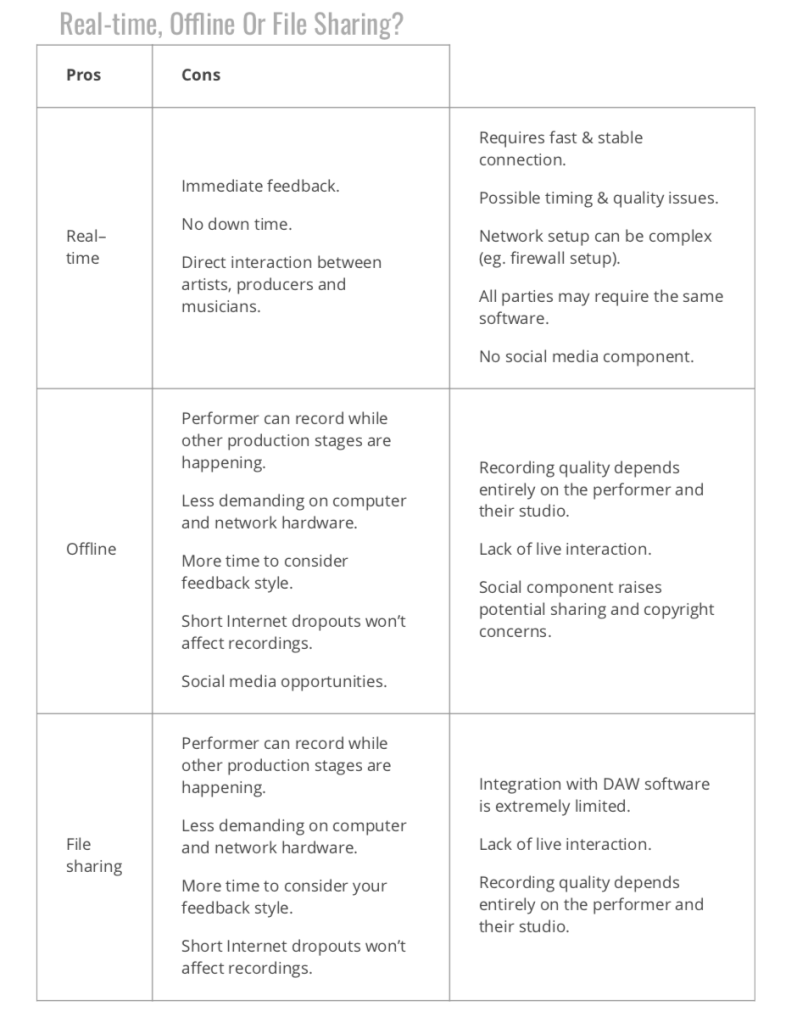
The only thing which will be affected is that I was hoping to be able to record together in the studio within the next few weeks which will no longer be possible. This is disappointing but won’t have any real effect on the outcome. I have read a Sound on Sound article by Andrea Pejrolo (2014) on remote collaboration which discusses different methods of musical collaboration over the internet.

Image 2: Different approaches to online collaboration (Pejrolos, 2014)

At the moment we are using simple file sharing through Google drive which is working fairly well. We both use Logic so the limited integration with DAW software as mentioned in the table above is not an issue. If lack of live interaction is something which limits us I may also use a real-time approach where we can video call and work on ideas together, or try one of the collaboration softwares suggested by Pejrolos such as Digital Musician.

References:

Clark, W. (1922). The Gantt Chart: A Working Tool of Management. New York: The Ronald Press Company.

Pejrolo, A. (2014). Remote Collaboration: Long Distance Recording Projects. [online] Sound On Sound. Available at: https://www.soundonsound.com/techniques/remote-collaboration [Accessed 17th March 2020].

Work in Progress and Planned Schedule

As we will both be travelling during April/May (unless decided otherwise by the Foreign Office due to current pandemic) this prevents us from being able to record anything together in person before the deadline. This should not be too much of an issue as all of my work will be done with MIDI input and Ciaran can use his own recording equipment. I will be returning to Plymouth on the 20th of April so I plan to use the mixing booths in Scott to finish mixing and mastering that week. The following week can then be used for any finishing touches and the release date will be in the beginning of May. These two weeks can also be used for designing cover art which I will do in Clip Studio Paint. I have purchased a small portable MIDI keyboard to take with me while traveling so all of my work can be done with my laptop. For now, our aim is to have something together by the end of the week in preparation for the presentation next Friday.

Here is my first work in progress which I have sent to Ciaran:

Introduction to the Project

In this module I have decided I would like to gain more experience in composing and producing my own music. I will be collaborating with my friend Ciarán who is a freelance music composer and sound designer, primarily for video games. Despite being friends for a number of years we have never collaborated before, but we believe our musical backgrounds and styles will be complementary to each other. Our overall goal is to produce two tracks and release them onto streaming sites such as Spotify, Apple Music, etc. Everything in this post below is what we discussed during our first in-person preparatory meeting on 28th February. We will both have creative input for this project, but I will be taking the role of producer while he will be doing any recording of live instruments.

When thinking about collaboration, one thing which came to mind is the recent debut collaboration between artists George Clanton and his ‘hero’ Nick Hexum of 311 with their two tracks ‘Crash Pad’ and ‘King for a Day’, released in September 2019 (bandcamp, 2019). These tracks include the nostalgic 90s sound which both Clanton and Hexum explore in their own separate projects, though in different ways. Hexum’s signature guitar style and nostalgic vocals in combination with Clanton’s ‘ethereal electronic backdrop’ mesh naturally to create the ‘ultimate musical getaway’ (Shafer, 2019). With the success of Clanton and Hexum’s explorations of their own 90s nostalgia in mind, I am hoping that our project will bring similar success for our different musical backgrounds being united.

My general musical background is in electronic music such as chillwave and vaporwave. I will typically use a combination of virtual synthesizers and samples to create music. I am also a classical pianist with specific interests in late Romantic and early 20th century composers such as Debussy, and will occasionally include piano in my work or use my skills and knowledge from this to inform my compositional choices. Ciarán’s work is very much centred around video games and so will vary wildly in genre and style. After meeting with him yesterday, he has suggested that he could bring his knowledge in styles such as chiptune to add a retro aspect to the project. He also has instrumental expertise in guitar and singing, as well as the Japanese shakuhachi flute, all of which I would very much like to include.

Hansen (2009) describes collaboration as when people work together ‘on a common task or provide significant help to each other’ (p. 14-15) and that the goal of collaboration is not collaboration but ‘better results’ (p. 15). I believe that we will provide significant help to each other as we are both keen to combine our compositional skills to make ‘better’ music. Ciarán has also mentioned that he would very much like to be able to post some original music on streaming sites, which he now has the opportunity to achieve with this project. Hansen states that some important steps in collaboration are to spot potential barriers and tailor solutions to them (p. 16-17). I would imagine the biggest barrier for us would be failing to complete the work in sufficient time. This will be avoided by allowing enough time to complete each task and keeping a consistent workflow in order to avoid what Huxham and Vangen (2005, p. 3) describe as ‘collaborative inertia’. There may also be artistic differences, though I believe we have enough trust between us to resolve these kinds of issues.

My next blog post will include discussion of musical ideas as well as a proposed timeline and set of deadlines for completing the work.

References:

Bandcamp, (2019). Crash Pad​/​King for a Day. [online] Available at: https://georgeclanton.bandcamp.com/album/crash-pad-king-for-a-day [Accessed 29th February 2020).

Hansen, M. (2009). Collaboration: How Leaders Avoid the Traps, Build Common Ground, and Reap Big Results. Boston, Massachusetts: Harvard Business Press.

Huxham, C. and Vangen, G. (2005). Managing to Collaborate : The Theory and Practice of Collaborative Advantage. Abingdon, Oxon: Routledge.

Shafer, E. (2019). 311’s Nick Hexum & George Clanton Evoke ‘The Ultimate Nostalgic Experience’ on ‘Crash Pad’: Exclusive. [online] Billboard.com. Available at: https://www.billboard.com/articles/news/8531401/311-nick-hexum-george-clanton-collab-two-singles [Accessed 29th February 2020].

Design a site like this with WordPress.com
Get started